My personal archives of half-formed thoughts and future manifestos—proof that I spend more time starting things than finishing them.
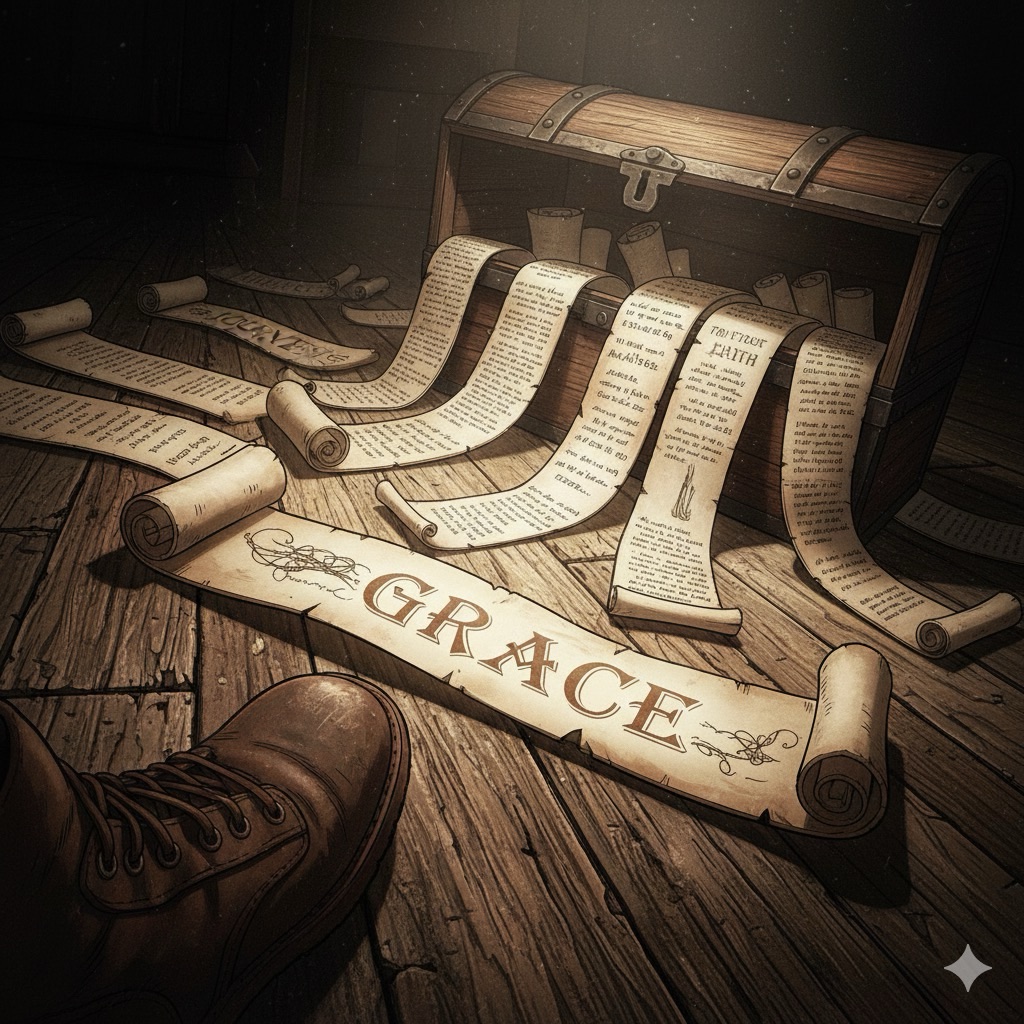
My personal archives of half-formed thoughts and future manifestos—proof that I spend more time starting things than finishing them.

“In the Bible, Love = obedience.”—Bryson Gray
That might sound cold or rigid at first glance. At least, that’s what I thought when I saw this post. Maybe that’s because I grew up in a world that taught me that love means acceptance, support, and warm feelings. “Obedience” feels like the opposite of all that: rules, pressure, and expectations.
Still, that short equation, Love=obedience, wouldn’t leave me alone. I kept coming back to it in prayer. Why was it lingering in the back of my mind?
So, I went to Scripture to try and understand it and I started seeing it everywhere:
John 14:15—“If you love Me, keep My commandments.”
John 15:10—“If you keep my commandments, you will abide in my love, just as I have kept my Father’s commandments and abide in his love.”
1 John 5:2—“By this we know that we love the children of God, when we love God and obey His commandments.”
2 John 1:6—“This is love: that we walk in obedience to His commands.”
Time after time, obedience and love, bound together. And that’s just in the New Testament.
But what do I do with that?
If being honest, sometimes I feel like Paul, when “I do not do what I want, but I do the very thing I hate.” (Romans 7:15)
As James rightly pointed out in Chapter 4 of his epistle, my passions are at war within me, and I don’t always succeed in the moment at overcoming temptations.
I fall short. Constantly.
And when I hold that up next to the verses above, I start to ask questions I don’t know how to answer.
If love equals obedience, then what does that say about my love for God? Can I still say I love Him when I keep falling short?”
Why does obedience feel so hard, even when I want to obey?
And what do I do with the guilt that creeps in when I know what’s right and still fail to follow through?
I want to love God more deeply, and I want that love to show up in how I live. But I am painfully aware of this gap between my desire to obey and my ability to follow-through.
That’s why I asked Dr. Shay Barrington if she would be willing to write a companion piece on the topic. What she wrote helped me stop spiraling and start hoping again.
If you’ve felt the same tension, if this idea unsettles something in you too, I hope you’ll read her reflection next.
➡️ Read Part 2: Obedience: Heaven’s Love Made Visible

It was Pentecost Sunday this past weekend and Brian Wagers was preaching. Somewhere near the end of his sermon, he said something that didn’t make sense to me at all, but somehow I knew it was important.
So I wrote it down.
“That which is assumed is healed, because that which is united to the Godhead is healed. So Christ’s full humanity means we receive the full deity of God in ourselves when the Holy Spirit rests upon us. So act like it.”
I didn’t know what it meant, but it sounded like seasoned Christian language, and something in me knew I needed to find out.
After I got home from church that day, I sat with it, looked up the theology behind it, and dug into what Brian was referencing.
Jesus didn’t just appear as a kind of human. He wasn’t God masquerading in flesh. He was fully human: body, mind, will, and emotions—and fully God.
Every part of humanity that He assumed is now joined to God. That’s what theologians mean when they say, “what is not assumed is not healed.”
The phrase comes from Gregory of Nazianzus, a fourth-century Church Father, writing against heresies that denied Jesus’ full humanity. His point was simple but profound:
“That which He has not assumed He has not healed; but that which is united to His Godhead is also saved.”— Gregory of Nazianzus Epistle 101, c. 382 AD
This became foundational in Christian theology, affirmed at the Council of Chalcedon (451 AD) and echoed across centuries: that Jesus took on the fullness of humanity to redeem the fullness of humanity. He had to take on the whole of humanity or none of it.
So now, when the Holy Spirit rests on us, we don’t just get guidance or peace.
We receive the fullness of God. Living in us. If that’s true, then God hasn’t just reached down.
He made His home in us.
And that’s where Brian’s last sentence landed like a stone:
“So act like it.”
That’s when I realized how much energy I still spend trying to manage how my faith looks to others.
I don’t lie about my faith. I don’t deny it. But I might be guilty of trying to soften the edges. I hesitate. I only share my experience with the gospel once it feels “safe.”
Especially around people I love: my parents, old friends, those from the Unitarian Universalist world I used to belong to. I know some of them already think I’ve lost it and have written me off. And I struggle to bring the good news to those closest to me.
But this struggle with boldness isn’t new for me.
Years ago, before I became a Christian, I went to a Sufi retreat with friends who had grown up going every year. And although I didn’t participate in the dancing in circles and the singing of chants late into the night, I was surprised when they started praising Jesus.
And for reasons I didn’t understand then, it offended me.
Looking back at my journal from that time, I found this telling entry:
I will praise the joy of Life. I will praise the Earth. I will praise the creations. But I won’t worship the Creator.
I had drawn a line in the proverbial sand back then. I didn’t want to go as far as worshipping my Creator.
And now, ironically, I find myself facing the same line—just in the opposite direction.
Back then, it was refusal to worship.
Now, it’s reluctance to witness.
Same fear. New disguise.
That’s why Brian’s sermon felt like a personal message to me.
“You should share the gospel more. Even though people will ridicule you… think you’re stupid for being religious… God is with you.”
He was reminding us what we carry. And how we ought to live in response to that.
Because I do know Jesus is real. I believe the gospel is true. And still, I catch myself holding back because I’m afraid of being dismissed before I even begin.
But then I read Acts 2 and the story of Pentecost.
Peter stands up in front of a crowd that’s already mocking him. “They are filled with new wine,” someone sneers. But Peter doesn’t explain himself. He doesn’t defend his tone. He doesn’t soften the message.
He just preaches.
That’s what struck me most this Pentecost, not the speaking in tongues, but the surrender. The apostles had been hiding weeks earlier. Now they’re proclaiming Jesus, fully exposed, defying safety.
They had the Spirit. And that was enough.
If the Holy Spirit really rests in me, if the fullness of God dwells in this ordinary body, then why am I worried about looking foolish?
Why am I still trying to sound smart enough and nuanced?
I have the Spirit of the living God.
Why would I care what anyone else thinks?
God is with me. God is in me.
So I’m done trying to control the optics.
I don’t need everyone’s approval. I have His presence.
Acts 2:15–16—“These people are not drunk, as you suppose… but this is what was uttered through the prophet Joel.”
They thought it looked crazy. Peter didn’t care.
They were misunderstood.
Mocked.
Spirit-filled.
So am I.
And I’m ready to act like it.

If the first half of Colossians 3 exposes my struggle with external validation, the second half of Colossians 3 reveals a deeper, internal battle: authenticity. In my last post, I reflected on how easily I let Facebook likes define my worth. But as I sat with verses 12-17 this week, I realized Paul’s words speak to something deeper than the superficial struggle over likes.
This isn’t only about stepping away from worldly validation; it’s about stepping into something new—clothing myself in compassion, kindness, humility, gentleness, and patience—qualities that shouldn’t just sit on the surface but sink into who I am.
It’s about putting on Christ.
And as I’ve been reflecting on that, one particular struggle has been stirring in me—one I am hesitant to share.
Comedy.
I’ve loved stand-up comedy for as long as I can remember. There’s something brilliant about the way comedians can take the raw, often uncomfortable realities of life and make us laugh.
Specifically, though, there is this one show I watch regularly called Kill Tony. For those who are unfamiliar, Kill Tony is a live comedy podcast hosted by Tony Hinchcliffe and Brian Redban. The format involves a live show where they pull random comics’ names out of a bucket for the chance to perform a one-minute set, then be critiqued and interviewed by Tony alongside big-name guests.
It’s a chaotic, anything-can-happen environment—raw, unfiltered creativity spilling out as these comics have to be sharp and punchy. The show has launched the careers of unknowns, affording opportunities they’d likely never get otherwise.
In a world where political correctness has impacted the comedic landscape, Kill Tony leans into this rough, unfiltered edge that’s messy and risky—and yeah, sometimes dicey. You never know what kind of show it’s going to be—from train wrecks to brilliance. It illustrates the artistry of stand-up, revealing how fast thinking, improvisation, and risk define the craft.
Shows like Kill Tony—which are irreverent, biting, racy, and boundary-pushing—still make me laugh, and I’m not uncomfortable with that.
But here’s the struggle: I’m wondering if I should feel uncomfortable with it.
I don’t think I should have to give it up, but something in me keeps questioning whether that’s true—or whether I’m justifying something I don’t want to change about myself, because Kill Tony is this wild, messy joy I cling to, and letting it go feels like losing a piece of me.
Colossians 3:12—“Put on then, as God’s chosen ones, holy and beloved, compassionate hearts, kindness, humility, meekness, and patience.”
That identity—being chosen, set apart—should shape everything. Not just how I love others, but what I let shape my mind and heart. It’s a call to wear these traits like armor, not just admire them—compassion that feels, humility that bends, patience that waits. Does my laughter match that?
Colossians 3:15—“And let the peace of Christ rule in your hearts, to which indeed you were called in one body. And be thankful.”
I’ve questioned whether I’ve felt that peace slipping when I indulge in humor that sometimes tears down rather than builds up. The laughs might come, but is there also a subtle dulling of my sensitivity toward what is good and true—until I’ve tuned out what matters? Peace ruling in my heart is what is supposed to keep me anchored.
Colossians 3:16—“Let the word of Christ dwell in you richly, teaching and admonishing one another in all wisdom, singing psalms and hymns and spiritual songs, with thankfulness in your hearts to God.”
That tension is hard because I don’t want to give it up, but I also want to be authentic and do my best to align my heart with God. But I know this: It’s not about changing myself to be right with God. It’s about abiding in Jesus and being changed from the inside out.
This is exactly the struggle—the tension between living fully for God and still enjoying the things that have shaped me, the things I love, the things that bring me joy.
I’m not looking for loopholes; I’m looking for truth. If I didn’t care, if I just shrugged and said, “Whatever, I’ll do what I want,” that would be a bigger issue.
But I do care.
What degree of strictness should I follow?
Because, yeah, Paul would probably have a stricter view. He talks about setting our minds on things above (Colossians 3:2), avoiding corrupting influences (Ephesians 5:3-4), and filling ourselves with what is true, noble, right, pure (Philippians 4:8).
So, on the surface, it might seem like the answer is cut it all out.
But I don’t think the question is just what should I cut out, but rather what is forming me?
What is shaping my heart, my thoughts, my desires?
Maybe instead of asking, how strict should I be, the better question is:
What is this doing to my soul?
Does it strengthen or weaken my ability to show love, patience, humility?
Does it influence my speech, my thoughts, my priorities in ways I don’t realize?
Comedy has been a part of my life, part of how I see and process the world. Giving up these things I love completely would feel like losing a part of myself. But at the same time, I don’t want to be the guy clinging to something that keeps me from growing into the person God is shaping me to be.
I think that’s where the real struggle lies. How do I hold onto the things that have shaped me without letting them own me?
I don’t think it’s about quitting Kill Tony cold turkey but rather being conscious of how it affects me. Because ultimately, I want my heart to stay tuned to Jesus.
Final Thought:
Yes, that’s what I want. For my mind and heart to be filled with His truth so fully that even my entertainment choices reflect Him. I don’t want to be desensitized to what grieves God or let something trivial weaken my sensitivity to Him, because if I do, I could drown out the voice I’m trying to hear.
I want to laugh and keep enjoying comedy, but not if it numbs my conscience or slowly shapes me into someone I don’t want to be.
I will keep praying on it, wrestling with what stays and what goes, chasing a joy that doesn’t fade. I know that holiness isn’t about following a list of rules—it’s about being transformed.
But in the end, I don’t want anything—not a show, not a joke—to have more of a hold on me than Christ does.


When I posted my first After Pew blog entry on Facebook, my heart raced as notifications lit up my phone—ten likes, then twenty, a comment from a friend saying, ‘Thanks for taking the time to share that.’
I was thrilled. It felt like people were connecting with what God put on my heart.
But the next post had diminishing returns. Half the reactions, if that. I found myself refreshing the page for an hour, as if that would make more likes appear, only to feel the silence settle in, heavier than the excitement I’d started with.
There’s something intoxicating about that little notification bubble. Psychologists agree that social media taps into our primal need for belonging. But the high never lasts.
One post soared, the next flopped. And just like that, I found myself second-guessing everything—was I posting too much? At the wrong times? Had I worn out my welcome? It was a rollercoaster the world designed, not God.
Galatians 1:10—“For am I now seeking the approval of man, or of God? Or am I trying to please man? If I were still trying to please man, I would not be a servant of Christ.”
That pull toward numbers is exactly why I had to stop posting my blog on Facebook. Now, I just write, let it go out into the world, and leave the rest up to God. I want to write for His glory, not for likes. I trust that He’ll use my words in ways I may never see.
That’s the reminder I needed: to focus on Christ, not the numbers.
Paul gets this pull. In Colossians, after declaring Christ’s sufficiency, he shifts in chapter 3 to how we should live it out:
Colossians 3:1-2—“If then you have been raised with Christ, seek the things that are above, where Christ is, seated at the right hand of God. Set your minds on things that are above, not on things that are on earth.”
Set my mind on things above. For me, that means asking myself ‘What Would Jesus Do?’ throughout my day. I didn’t take part the first time around, but I remember how the phrase and the bracelets took hold of the zeitgeist in the ’90s. It’s a question worth reviving, not as a catchphrase, but as a real guide for aligning our hearts with God’s will.”
Setting my mind on things above also means filling my space with what lasts: Scripture and prayer. As I’ve been taught: praying is my time to talk to God and reading the Bible is my time for Him to talk to me.
This morning, instead of reaching for my phone I reached for my pocket Bible and read James Chapter 4: ‘Draw near to God and He will draw near to you.’ No metrics, just truth.
As I was loading the dishwasher, I hummed to myself ‘Here I Am to Worship’, doing as Colossians 3:16 says, ‘singing psalms and hymns and spiritual songs, with thankfulness in your hearts to God.’
Even silence works: ten minutes with no screen, just breathing, asking God to renew me. These aren’t fixes; they’re rhythms. They remind me my blog isn’t my life—Christ is.
I imagine Paul writing Colossians from prison, yet free in Christ. If he could let go of earthly approval under that pressure, then I can strive to do the same.
Colossians 3:5—“Put to death therefore what is earthly in you: sexual immorality, impurity, passion, evil desire, and covetousness, which is idolatry.”
Chasing validation was idolatry—putting numbers above God. They weren’t just bad habits to manage; they are remnants of a life I no longer live. When I place something above God, I sin.
Paul reminds us to actively reject these things and replace them with love for Christ.
Pastor John’s weekly reflection was an excellent reminder: what I dwell in shapes me. When we steep ourselves in Christ—His purpose, His peace—feelings like frustration or self-doubt lose their bite.
I don’t need a notification bubble to tell me I’m enough if I let the word of Christ dwell within me richly. Numbers rise and fall, but His truth stands unshaken.
Starting my day off with a Psalm rather than my phone renews me. Filling my mind with Scripture instead of screens anchors me in something eternal.
The world is loud, and it’s easy to drift—one scroll, one refresh, one fleeting dopamine hit at a time. But what if I tuned out the noise?
What’s one way I could turn it down today?
By setting my mind on things above. By choosing worship over worry. By chasing Christ, not approval.
His peace is waiting.
He’s my life—not the metrics I chase.

I’m still in Colossians, working through it little by little, leaning on sermon videos from Pastor John. My process has a steady rhythm—reading, listening, reflecting. Tonight, I’m studying in the quiet upstairs of my church, while the joyful chaos of AWANA and youth group rises up around me. My kids are elsewhere in the building, immersed in their own time of learning and fellowship, while I sit here with my Bible open, seeking to be rooted and built up in Christ myself.
In Chapter 2, Paul describes his mission as a “great struggle,” a deep labor for believers he’s never even met. He strives for them to be encouraged and united in love, shielded from deception. He’s keenly aware of how subtly people can drift toward teachings that promise much but deliver little apart from Christ.
The church in Colossae—and nearby Laodicea—had to be vigilant. Laodicea was a wealthy, self-sufficient city. That kind of comfort carried the risk of making faith feel like a surface-level label rather than a foundation. I see that same danger today. It’s only been a year since my baptism and I’m still passionate about building my relationship with Jesus, but I can see how easy it could be to settle into routine and let spiritual complacency take hold.
I’ve observed many Christians in my day who attend church on Sundays, yet it seems more out of habit than a true reflection of their faith. And more people still seem to wear Christianity like a fashion accessory, with no roots at all.
But, how am I living out my faith beyond Sunday mornings? Is my walk with Jesus deepening, or am I allowing complacency to creep in?
Colossians 2:6-7 —“So then, just as you received Christ Jesus as Lord, continue to live your lives in him, rooted and built up in him, strengthened in the faith as you were taught, and overflowing with thankfulness.”
Paul is pointing out that just as we received Christ by faith, we must also continue to live by faith. It’s not a one-time decision—it’s a daily walk.
Colossians 2:8 – “See to it that no one takes you captive through hollow and deceptive philosophy, which depends on human tradition and the elemental spiritual forces of this world rather than on Christ.”
Paul warns against the deception of human tradition and empty philosophies. And today, there are so many ’empty philosophies’ being worshipped: Moral Relativism, Self-Worship and Secular Humanism, New Age Spirituality, Postmodernism, Consumerism. In a world of competing voices and shifting ideologies, how can we ensure that we, and future generations, are rooted in Christ’s truth? How can we guard ourselves and others from these philosophies that threaten to lead us away from the sufficiency of Christ?
Colossians 2:9-10 —“For in Him the whole fullness of deity dwells bodily, and you have been filled in Him, who is the head of all rule and authority.”
Christ is not just a teacher or example—He is fully God, offering us the fullness of life. This fullness is marked by a transformation of the heart, symbolized through baptism, where we die with Christ and rise to new life. Am I living with the conviction that Christ is enough? Or am I seeking fulfillment in material possessions and the approval of others? Is my life showing evidence of new life in Christ, or are old habits still influencing my actions?
In reflecting on Colossians 2, I’m reminded that living in Christ isn’t something that happens on autopilot. It’s a call to actively stand firm in the truth. I need to keep growing, keep myself rooted in the fullness of Christ, especially with all the distractions around me. Faith isn’t static—it’s a living, growing relationship that transforms every part of our lives.
How do you keep your faith active beyond Sundays?
Ever feel complacent in faith? What pulls you back?
Who could you encourage to stay strong in faith?

I recently got this Scripture Journal Bible — the kind with the text on one page and blank lines on the other for notes. It’s a hefty thing, about 28 pounds of Scripture, but I love how it invites me to wrestle with the words. I’m starting with Colossians, studying it in my own time. I am leaning on sermon videos my pastor preached three years ago when he first came to our church.
At the start of Colossians, Paul greets the believers of Colossae as saints and faithful in Christ—not because they’re perfect, but because the gospel has taken hold in their lives. Roots like that grow something. He reminds them that this same gospel is spreading all over the world, just as it has in Colossae. It’s a living thing, spreading and producing, and it’s doing the same in us.
Colossians 1:9-10 —”And so, from the day we heard, we have not ceased to pray for you, asking that you may be filled with the knowledge of his will in all spiritual wisdom and understanding, so as to walk in a manner worthy of the Lord, fully pleasing to him, bearing fruit in every good work and increasing in the knowledge of God.”
Paul prays they’d be filled with the knowledge of God’s will and live it out, bearing fruit in every good work and increasing in the knowledge of God.
The Cycle of Faith
It’s a cycle that keeps unfolding—learning who God is, stepping into what He calls us to, seeing fruit spring up, then digging deeper.
The cycle works like this: As we seek to live in a way that pleases God, He fills us with His wisdom and strength. This filling equips us to live out the gospel in our actions, which in turn bears fruit—visible evidence of a life rooted in Him. As we bear fruit, our understanding of God deepens, drawing us closer to Him. The more we know Him, the more we rely on Him, and the more He fills us again. This ongoing cycle of learning, living, bearing fruit, and growing in knowledge keeps our faith alive and active.
This cycle of learning, living, bearing fruit, and growing in knowledge isn’t just theoretical—it’s something I’ve seen in my own life.
For years, I struggled with my temper. My anger would go from zero to ten in an instant, and I often felt powerless to control it. But since I’ve been saved, it’s like a weight has lifted. I won’t say I never get irritated, but now, instead of rage, it’s more of an annoyance that passes. God is reshaping my reactions, teaching me patience, and helping me forgive—not just others but also myself. That’s fruit I could never have produced on my own.
Another change I never expected was in how I interact with people. In my 30’s, I became more withdrawn, socially awkward, and anxious in large groups. I mainly stayed at home. But as I’ve grown in faith and become part of a church, something shifted. I’m more open, more comfortable in crowds, and happy to engage with people. I see this as part of God’s work in me, drawing me out of myself to be part of something bigger.
And it hasn’t just been me. My wife has seen these changes too. They’ve strengthened her own belief that God is real and working in our lives.
Paul’s words to the Colossians hit home because, like them, I’ve wrestled with faith. I’ve let the world’s expectations shape me. But when I look at what God has done, I see that faith isn’t static. It moves. It grows. It bears fruit.
And this cycle isn’t new—Jesus points it out too:
John 15:5 — “Whoever abides in me and I in him, he it is that bears much fruit.”
If I’m not abiding, nothing will grow. Am I truly abiding in Him? Abiding means staying rooted in Christ—trusting, obeying, and drawing life from Him. And that is only possible because of what He’s already done for us:
Colossians 1:13-14— “He has delivered us from the domain of darkness and transferred us to the kingdom of his beloved Son, in whom we have redemption, the forgiveness of sins.”
This sums up the core of the gospel, plain and simple—what God has done for us through Christ. We were trapped in sin, but God rescued us, gave us a new kingdom, and forgave us through Jesus. It’s the greatest good we’ve been given, a gift—not something we are owed. Before, I saw faith as something personal, maybe even individualistic. But seeing God as a loving Father who’s rescued us changes how I live it out—faith isn’t just mine; it’s meant for something bigger.
Faith That Moves
That’s why Paul’s words to the Colossians resonate—like them, I’ve wrestled with what faith really is and how easily extra things creep in.
The Colossians were tangled up in extra stuff—pagan ideas, Jewish legalism, and they blended them into their faith. I get it. It’s easy to let the world’s expectations creep into my thinking in my pursuit of approval or security. But Paul’s prayer cuts through: Faith that’s alive moves. James drives it home:
James 2:17 — “Faith by itself, if it does not have works, is dead.”
It’s not about earning—it’s the natural overflow of a life deeply rooted in Christ. What is my faith producing?
The good news is, God doesn’t leave us empty-handed. He fills us with His strength, His knowledge, His patience. It’s not my effort holding this up—it’s Him.
Philippians 1:6 — “He who began a good work in you will bring it to completion.”
He’s the source; I’m just a branch, meant to live this gospel out and let the cycle keep going—learning, growing, bearing fruit.
Abiding in Christ means staying rooted in Him, even when it’s uncomfortable. I’m slowly letting go of the fear of my friends and family judging me for becoming a Christian and accepting Jesus as my Lord and Savior.
Just today, a friend confronted me with strong language, asking if it was true that I was “born again”. A year ago, that might have shaken me. But these last two years have been transformative for me and my family. As we grow in faith, we feel more whole, like we’re on the right path.
Things are falling into place—not because life is easier, but because God keeps reinforcing our faith and guiding our steps. And I know He’s not done. The work He started in me—He will see it through.
The cycle of learning and growth keeps going.
My goal today is to lean into this—learning God’s will and living it for His glory. Colossians 1:10 ties it together: a life pleasing to Him bears fruit and deepens our knowing. Today, I can abide in Him by trusting His lead and letting that fruit show through how I live.
What fruit is your faith producing?
Where have you seen spiritual growth that surprised you?
