Tag: BiblicalWisdom

  • So Act Like It: Pentecost, Presence, and Boldness

    It was Pentecost Sunday this past weekend and Brian Wagers was preaching. Somewhere near the end of his sermon, he said something that didn’t make sense to me at all, but somehow I knew it was important.

    So I wrote it down.

    “That which is assumed is healed, because that which is united to the Godhead is healed. So Christ’s full humanity means we receive the full deity of God in ourselves when the Holy Spirit rests upon us. So act like it.”

    I didn’t know what it meant, but it sounded like seasoned Christian language, and something in me knew I needed to find out.

    After I got home from church that day, I sat with it, looked up the theology behind it, and dug into what Brian was referencing.

    Jesus didn’t just appear as a kind of human. He wasn’t God masquerading in flesh. He was fully human: body, mind, will, and emotions—and fully God.

    Every part of humanity that He assumed is now joined to God. That’s what theologians mean when they say, “what is not assumed is not healed.”

    The phrase comes from Gregory of Nazianzus, a fourth-century Church Father, writing against heresies that denied Jesus’ full humanity. His point was simple but profound:

    “That which He has not assumed He has not healed; but that which is united to His Godhead is also saved.”Gregory of Nazianzus Epistle 101, c. 382 AD

    This became foundational in Christian theology, affirmed at the Council of Chalcedon (451 AD) and echoed across centuries: that Jesus took on the fullness of humanity to redeem the fullness of humanity. He had to take on the whole of humanity or none of it.

    So now, when the Holy Spirit rests on us, we don’t just get guidance or peace.

    We receive the fullness of God. Living in us. If that’s true, then God hasn’t just reached down.

    He made His home in us.

    And that’s where Brian’s last sentence landed like a stone:

    “So act like it.”

    That’s when I realized how much energy I still spend trying to manage how my faith looks to others.

    I don’t lie about my faith. I don’t deny it. But I might be guilty of trying to soften the edges. I hesitate. I only share my experience with the gospel once it feels “safe.”

    Especially around people I love: my parents, old friends, those from the Unitarian Universalist world I used to belong to. I know some of them already think I’ve lost it and have written me off. And I struggle to bring the good news to those closest to me.

    But this struggle with boldness isn’t new for me.

    Years ago, before I became a Christian, I went to a Sufi retreat with friends who had grown up going every year. And although I didn’t participate in the dancing in circles and the singing of chants late into the night, I was surprised when they started praising Jesus.

    And for reasons I didn’t understand then, it offended me.

    Looking back at my journal from that time, I found this telling entry:

    I will praise the joy of Life. I will praise the Earth. I will praise the creations. But I won’t worship the Creator.

    I had drawn a line in the proverbial sand back then. I didn’t want to go as far as worshipping my Creator.

    And now, ironically, I find myself facing the same line—just in the opposite direction.

    Back then, it was refusal to worship.

    Now, it’s reluctance to witness.

    Same fear. New disguise.

    That’s why Brian’s sermon felt like a personal message to me.

    “You should share the gospel more. Even though people will ridicule you… think you’re stupid for being religious… God is with you.”

    He was reminding us what we carry. And how we ought to live in response to that.

    Because I do know Jesus is real. I believe the gospel is true. And still, I catch myself holding back because I’m afraid of being dismissed before I even begin.

    But then I read Acts 2 and the story of Pentecost.

    Peter stands up in front of a crowd that’s already mocking him. “They are filled with new wine,” someone sneers. But Peter doesn’t explain himself. He doesn’t defend his tone. He doesn’t soften the message.

    He just preaches.

    That’s what struck me most this Pentecost, not the speaking in tongues, but the surrender. The apostles had been hiding weeks earlier. Now they’re proclaiming Jesus, fully exposed, defying safety.

    They had the Spirit. And that was enough.

    Final Thought:

    If the Holy Spirit really rests in me, if the fullness of God dwells in this ordinary body, then why am I worried about looking foolish?

    Why am I still trying to sound smart enough and nuanced?

    I have the Spirit of the living God.

    Why would I care what anyone else thinks?

    God is with me. God is in me.

    So I’m done trying to control the optics.

    I don’t need everyone’s approval. I have His presence.

    Acts 2:15–16“These people are not drunk, as you suppose… but this is what was uttered through the prophet Joel.”

    They thought it looked crazy. Peter didn’t care.

    They were misunderstood.

    Mocked.

    Spirit-filled.

    So am I.

    And I’m ready to act like it.

  • Strumming God’s Design: Freedom in Boundaries

    Reflections on Proverbs 20

    We don’t usually think of boundaries as beautiful.
    But what if they’re what make beauty possible in the first place?

    This week at church, Brian, our pastoral resident, preached on Proverbs 20. I was serving in the nursery during the service, so I didn’t get to hear it live. But later that day, I sat down with the livestream so I could catch up. I’ve been writing through each chapter of Proverbs week by week, and I didn’t want to skip this one.

    The chapter covers a range of topics: justice, speech, honesty, discernment. But most of it, as Brian pointed out, can be grouped under “moral boundaries.” These are the kinds of limits that don’t restrict life as much as shape it. But that only makes sense if you believe life has a shape in the first place.

    If you’ve ever tried to play guitar without knowing how, you’ll know what I mean.

    Imagine picking up a guitar for the first time. You can do whatever you want with it. Bang on the strings, twist the knobs, start strumming, no instruction, no structure, just doing whatever feels good. You’re technically free. But what you’re playing probably sounds chaotic. The guitar was built with certain boundaries in mind. Strings have pitch. Frets divide sound. Chords form harmonies. There’s a design to it, a right way to approach it. And until you learn them, what comes out isn’t music.

    It’s just noise.

    Now picture someone who’s spent time learning how the guitar works. They know their scales, their chord shapes and rhythm. They’ve embraced limitations such as finger positioning, timing, even discomfort. But now, when they pick up that same guitar, something beautiful happens.

    They can make beautiful music. They can improvise and can even break the “rules” with intentionality because they know the structure they’re working within. They aren’t less free than the person banging on strings at random; they’re more free.

    The structure didn’t limit them. It released them.

    God’s moral boundaries are like that.

    They’re not barriers to keep us from living, rather they are the framework that helps us live well. Proverbs 20 brings this design to life, starting with purpose.

    Proverbs 20:5“The purpose in a man’s heart is like deep water, but a man of understanding will draw it out.”

    Without wisdom, we stay at a surface level, blind to our own purpose. But through God’s Word and Spirit, we are taught how to live in tune with His design.

    As Brian pointed out, and this was the statement that really stuck with me, if life didn’t have an ultimate purpose, then wisdom wouldn’t even be a category. There’d be no such thing as “a good way to live”, only preference, survival, or self-expression.

    But wisdom assumes a telos. A goal. A design that can either be honored or ignored. That design is revealed in how we actually live.

    Proverbs 20:11“Even a child makes himself known by his acts, by whether his conduct is pure and upright.”

    Basically, you can’t fake who you really are for very long because your actions always give you away. The verse mentions kids because they haven’t learned to hide their motives yet. But honestly, adults aren’t much better at hiding their true selves.

    Your life is like a walking advertisement for what you actually care about, not what you say you care about. You might think you can be one way at church and another way everywhere else, but people aren’t stupid; your actions speak volumes.

    This brings up a deeper question about control. If our character inevitably shows through our actions, and if there’s a design we’re meant to follow, what role do we actually play in shaping our own lives?

    Proverbs 20:24“A man’s steps are from the Lord; how then can man understand his way?”

    For someone like me, who spent a lot of life trying to chart my own course and make sense of it afterward, that’s actually comforting. I don’t know what’s coming next. I’ve had plans fade, doors close, things not work out. But the more I’ve come to value God above everything else, the less I feel the need to force everything to make sense right now. I don’t have to be the architect. God’s wisdom is better than mine, and His boundaries lead to a kind of freedom I never had when I was just doing my own thing.

    I used to fear that giving up control would mean giving up identity. Now I’m learning that trusting God is where my identity actually takes shape.

    But here’s the thing about living within these boundaries: we are not meant to live in them alone. It takes a community to keep you in tune.

    That’s why discipleship has become so important to me. I need people who know me well enough to help me hear what’s really going on in my heart.

    Proverbs 20:27“The spirit of man is the lamp of the Lord, searching all his innermost parts.”

    God sees me clearly. And when I let friends, mentors, my church community in, they help me see clearly too. Not just in the big decisions, but in the small, daily ones where integrity is built.

    Final Thought:

    Whether you’re a believer or a skeptic, I wonder if the guitar image lands for you. The idea that what looks like restriction might actually be the path to something more beautiful than chaos ever promised.

    That the shape of your life matters because it was meant to matter.

    That maybe, just maybe, the strings weren’t meant to be broken, but played.

  • Solomon’s Prayer: 1 Kings 8

    When I was first exploring Christianity, I thought that following God was about seeking truth and trying to live in a way that earned His approvaI. I wasn’t trying to be perfect; I knew that wasn’t possible. But I thought that if I searched hard enough and did the right things, I could find God and make myself right with Him. It wasn’t until I began to truly understand the gospel that things started to fall into place.

    Jesus didn’t save me because I figured out the right buttons to push or because I was making better choices—He saved me knowing I would still mess up. He went to the cross not just for the world, but for me, and His forgiveness wasn’t something I had to earn. I simply had to believe and to accept the gift He was offering me.

    In my searching and brokenness, Jesus found me and offered what I was truly longing for: redemption, a relationship, and purpose. And from that place of grace, I’m learning what it means to live a life that serves and honors Him.

    That is the beauty of 1 Kings 8. Solomon stood before the altar and prayed one of the longest prayers recorded in Scripture (1 Kings 8:22-53). As he dedicated the temple, deeply aware of who God is, he asked God to hear the prayers of His people when they sinned, when they suffered, when they turned back to Him in repentance.

    Not if, but when.

    1 Kings 8:35-36—”When heaven is shut up and there is no rain because they have sinned against You, if they pray toward this place and acknowledge Your name and turn from their sin, when You afflict them, then hear in heaven and forgive the sin of Your servants.”

    Solomon knew the human heart would stray. And yet, he asked God to dwell among them anyway. That’s a great example for us.

    Solomon’s prayer reminds us that God never expected perfection—only humility and a willingness to invite Him to dwell with us. He begins with worship, declaring God’s faithfulness to His covenant and His promises to David. God had been true to His word, and Solomon knew He would continue to be. He wasn’t just asking for help or offering thanks—he was recognizing God’s rightful place at the center of everything.

    I talk to God often—offering gratitude, asking for help, lifting up prayers for others. But how often do I invite Him into my life beyond that? Do I think to welcome Him into my thoughts as I go about my day? Into my decisions, big and small? Into my moments of boredom, frustration, or joy—not just with words, but with an openness to His presence?

    1 Kings 8:27“But will God indeed dwell on the earth? Behold, heaven and the highest heaven cannot contain You, how much less this house that I have built!”

    Solomon acknowledges that no temple could ever contain the fullness of God, yet he pleads with God to hear the prayers of His people—whether they are standing in the temple or far from it. God’s mercy is not confined to a place but flows from His heart.

    Solomon anticipates the reality of sin and pleads for God’s forgiveness and restoration when His people humble themselves and repent.

    Solomon acknowledges human weakness, saying, “There is no one who does not sin” (8:46), and asks God to show mercy when His people turn back to Him, even from a place of exile and discipline.

    1 Kings 8:39-40“For You, You alone, know the hearts of all the children of mankind, that they may fear You all the days that they live in the land that You gave to our fathers.”

    Final Thought:

    This is what I took away from 1 Kings 8. Solomon didn’t stand before God on the basis of what he had built, but on who God is. And that’s exactly what I’ve come to understand in my own walk with Christ.

    My confidence before God isn’t found in what I’ve done—or what I’ll ever do—but in what Christ has already done for me on the cross

    Solomon’s prayer shows us that God was never expecting perfect people. He was looking for humble hearts willing to turn back to Him in repentance.

    God hears.
    God forgives.
    God dwells with us.

    May we rest in this truth: we are heard, we are forgiven, we are welcomed—not because we are perfect, but because He is merciful.


  • Losing The Game: And Finding Jesus

    Ever play The Game? You know, that weird anti-memory thing where the rule is: if you think about The Game, you lose? I hadn’t thought about it in a while—until this afternoon. Probably because I caught myself doing the same thing with Jesus.

    I was folding laundry, not thinking about Him at all, and then it hit me: “Wait, I wasn’t thinking about Jesus.” Boom. I lost The Game.

    Only, this is not a game—it’s my walk with Him.

    It’s weird how that works. The Game’s whole trick is you’re fine until you remember it, and then you lose.

    And today, I realized that’s how it goes with God sometimes. I’ll be cruising through my day—driving, writing, more driving—and then it hits me. I haven’t invited Him into it. Maybe I’m too caught up in the id—all those little wants and worries pulling me sideways.

    I just… forget.

    And the second I notice, it’s like losing The Game all over again. Except instead of a silly “dang it,” it’s a quiet, “Hey, where’d you[Jesus] go in my head?”

    The idea to try and always be thinking of Jesus came to me as I was reciting 1 Thessalonians 5:16-18 to myself.

    1 Thessalonians 5:16-18“Rejoice always, pray without ceasing, give thanks in all circumstances; for this is the will of God in Christ Jesus for you.”

    This is like a mantra to me. I say these verses all the time because they’re such a concise prescription of what a Christian ought to do. When we who want to be good Christians ask ourselves, “What can we do?” Paul says, “Rejoice always, pray without ceasing, give thanks in all circumstances.”

    Man, that’s a tall order. Pray without ceasing?

    Like, every second?

    It sounds like we’re supposed to be muttering prayers non-stop. But as I’ve been studying Colossians 3, 1 Kings 8, and Proverbs, I’ve seen a recurring theme.

    Colossians 3:16-17“Let the word of Christ dwell in you richly, teaching and admonishing one another in all wisdom, singing psalms and hymns and spiritual songs, with thankfulness in your hearts to God. And whatever you do, in word or deed, do everything in the name of the Lord Jesus, giving thanks to God the Father through him.”

    1 Kings 8:27
    “But will God indeed dwell on the earth? Behold, heaven and the highest heaven cannot contain you, how much less this house that I have built!”

    Proverbs 8:17
    “I love those who love me, and those who seek me find me.”

    It’s about inviting God into our life and keeping Him in the mix—having a constant awareness. Like breathing. You don’t think about every breath, but it’s always there. So that’s a goal I’ve set for myself.

    It’s not easy. The other morning, I began to stress when I noticed how many medical appointments had racked up on my calendar, and my mind was spiraling.

    No rejoicing. No thanks. Definitely no Jesus.

    Then I caught it—like remembering The Game—and thought, “Okay, I’ve lost this round.” But here’s the twist: losing’s not the end. When I realize I’ve drifted, it’s a chance to invite Him back in.

    I stop, take a breath, and say, “Hey, Jesus, come back into this.” Like Paul’s saying: start rejoicing now. Pray right here. Give thanks even when your mortality nudges its way into your thoughts.

    Final Thought:

    I’m not there yet—nowhere close. Sometimes I’m rooted in Him, like Colossians keeps telling me to be. And other times, it takes that “oh shoot, I lost” moment to pull me back. Maybe that’s what Paul meant—living so tuned to God that drifting feels like losing, and coming back feels like home.

    It’s a weird little parallel, this Game thing, but at least it got me thinking:

    How often do I let Him slip out of focus?

    And how quick can I turn it around when I do?

    But I think that’s the point. The goal isn’t perfection; it’s persistence.

    Keeping Jesus in the game—not The Game, but my game, my life. Every time I catch myself forgetting, it’s a win. Because I’m remembering to bring Him in again.

  • The Temple and the Palace: Misplaced Priorities (1 Kings 5-7)

    There’s something deeply revealing about how we allocate our time and resources. As I’ve sat with chapters 5 through 7 from 1 Kings, I’ve been moved by a sobering numerical contrast I noticed—seven years to build God’s temple, thirteen years for Solomon’s personal palace. This detail isn’t merely architectural history; it’s a mirror held up to our own lives.

    1 Kings 6:38“So it was that Solomon was seven years in building it” (referring to the temple).

    1 Kings 7:1—”But Solomon was building his own house thirteen years, and he finished all his house” (referring to the palace.)

    One thing that strikes me about 1 Kings 5-7 is how subtly Solomon’s focus drifted. Every cedar beam, every carved cherubim, every detail mattered; his devotion was genuine—the temple specifications were followed meticulously, the materials were the finest available, the craftsmanship exquisite. Yet the temple received seven years, the palace thirteen, revealing a gradual drift in what captivated his heart. Personal ambition began to outpace spiritual dedication, a quiet shift unnoticed at first.

    I’ve experienced this same pattern in my spiritual journey. My days aren’t divided between constructing temples and palaces, but between spiritual nourishment and worldly distractions. What begins as a quick scripture reading can easily dissolve into hours of scrolling on X and a moment of intended sermon study turns into a YouTube video rabbit hole. My “temple time” shrinks while my “palace time” expands, and I’ve found that it’s not a dramatic fall but a subtle drift—one that’s easy to overlook. As Jesus said:

    Matthew 6:21—”For where your treasure is, there your heart will be also.”

    My screen time has become a revealing metric of where my treasure—and thus my heart—truly lies.

    That subtle drift became undeniable when I checked my screen time last month. What began as a simple curiosity became a spiritual wake-up call when I saw the numbers: 60 minutes in my Scripture memorization and Bible apps versus 2+ hours on YouTube, Facebook, and other apps. My temple-to-palace ratio was severely imbalanced.

    But in that imbalance, I find unexpected openings. The beauty of my situation – driving for Uber as a secondary income – is that it creates unique pockets of time. These moments between rides could become either “temple-building time” or “palace-building time.” Not in the literal sense, of course, but in how they either connect me to my deeper purpose or simply pass in distraction.

    Practical Temple-Building in Digital Age

    What might intentional “temple-building” look like in the spaces between responsibilities?

    What if I could more intentionally create playlists—not just for entertainment, but to nourish my soul during those in-between moments?

    Or take those moments of waiting—whether in traffic, at a store, or between tasks—and use them to immerse myself more consistently in God’s word?

    A brief Bible passage during a lull could anchor me in His presence. A quick prayer—driving the kids or pausing mid-task—could refocus my heart with a single word.

    How often do I rush through my day without taking a second to pause and notice the gifts around me? The gratitude is there, but even just one more 30 seconds to thank God—for His presence, loved ones, or quiet—could shift me.

    Scriptural Reflection: The Quiet Work of Temple-Building

    1 Kings 6:7“When the house was built, it was with stone prepared at the quarry, so that neither hammer nor axe nor any tool of iron was heard in the house while it was being built.”

    There was a quiet, deliberate nature to the work, a reflection of intentionality that invites me to consider how I build my spiritual “temple.” The spiritual work of transformation often isn’t loud or dramatic—it happens in the quiet, purposeful moments, like those between rides or in small pauses throughout the day.

    1 Kings 6:12-13—”If you follow my decrees, carry out my regulations, and keep all my commands and obey them, I will fulfill through you the promise I gave to David your father. And I will live among the Israelites and will not abandon my people Israel.”

    This reminds me that when we commit to spiritual disciplines, God’s presence fills those moments and continues to build our temple from the inside out. It’s not always the grand gestures that build a life of faith but the small, faithful actions over time.

    Questions for My Journey

    As I reflect on these chapters through the lens of my specific situation, I’m holding these questions:

    • What if those moments before opening a streaming app became invitations to brief spiritual connection?
    • How might I create “temple spaces” within my driving routine?
    • What would a healthy “seven-to-thirteen ratio” look like in my daily rhythms?

    Final Thought:

    I must confess that I’ve often dismissed my own digital distractions as “harmless downtime.” Yet Solomon’s story reminds me that patterns of attention eventually shape the temple of our hearts. Every time I find myself scrolling, every podcast episode I watch, every playlist I listen to contributes to who I’m becoming.

    In this season, I’m learning that spiritual formation isn’t just about grand commitments but about reclaiming those small moments that so easily slip away. The temple was built, not in dramatic gestures, but in the small, faithful choices made each day.

    How About You?

    Where might God be inviting you to shift your attention today?

    In the spaces between life’s busyness, what kind of ‘temple building’ might be possible for you?

    What small, intentional choices might you make today?

  • Wisdom at the Threshold: Lessons from 1 Kings 1-4

    I try to keep a balanced diet in my Bible reading—Old Testament, Gospels, and Epistles. Right now, my wife and I are studying 1 Kings with our good friends. They are the same friends who first invited us to church and helped lead us to Christ. We’ve been doing weekly Bible study with them for a few years now. It is one of the most important parts of our faith journey.

    As we’ve been reading 1 Kings, it’s gotten me thinking about transitions—how the old fades, the new struggles to take hold, and everything feels uncertain. That’s 1 Kings in a nutshell.

    David is dying, frail and unable to keep warm. Adonijah is already celebrating, assuming the throne is his. Solomon, young and unproven, suddenly finds himself securing his rule with difficult decisions and a kingdom to steady. Then God appears to him in a dream, offering anything he desires. He could have asked for wealth or vengeance—but he chose wisdom.

    1 Kings 3:9“Give your servant therefore an understanding mind to govern your people, that I may discern between good and evil, for who is able to govern this your great people?”

    I’m over here with my coffee, thinking about my own life. No crown, just the weight of leading a family—loving my wife well, raising my kids, and trying to walk wisely in the everyday.

    Solomon’s choice challenges me—seek wisdom first. He is stepping into leadership as Israel enters a new era—one marked by weighty decisions and the challenge of ruling well. Solomon’s request for wisdom doesn’t just shape his reign—it reveals the kind of king he hopes to be.

    I don’t have a kingdom to rule. But I do have responsibilities—my marriage, my kids, my work, and the way I show up for others. And in all of it, I feel the pull to rely on my own instincts, to make decisions based on what seems best in the moment. But Solomon reminds me to ask first. To stop and seek wisdom before anything else. I need to remember that.

    Wisdom, after all, isn’t just knowing the right thing—it’s living it.

    Proverbs 4:7“The beginning of wisdom is this: Get wisdom, and whatever you get, get insight.”

    Solomon’s reign begins with that pursuit, and it ripples outward. His wisdom isn’t just for himself; it brings justice, as seen in the case of the two women fighting over a baby. It establishes order, structure, and peace to the kingdom. And it makes me wonder: am I seeking wisdom in a way that blesses others, not just myself?

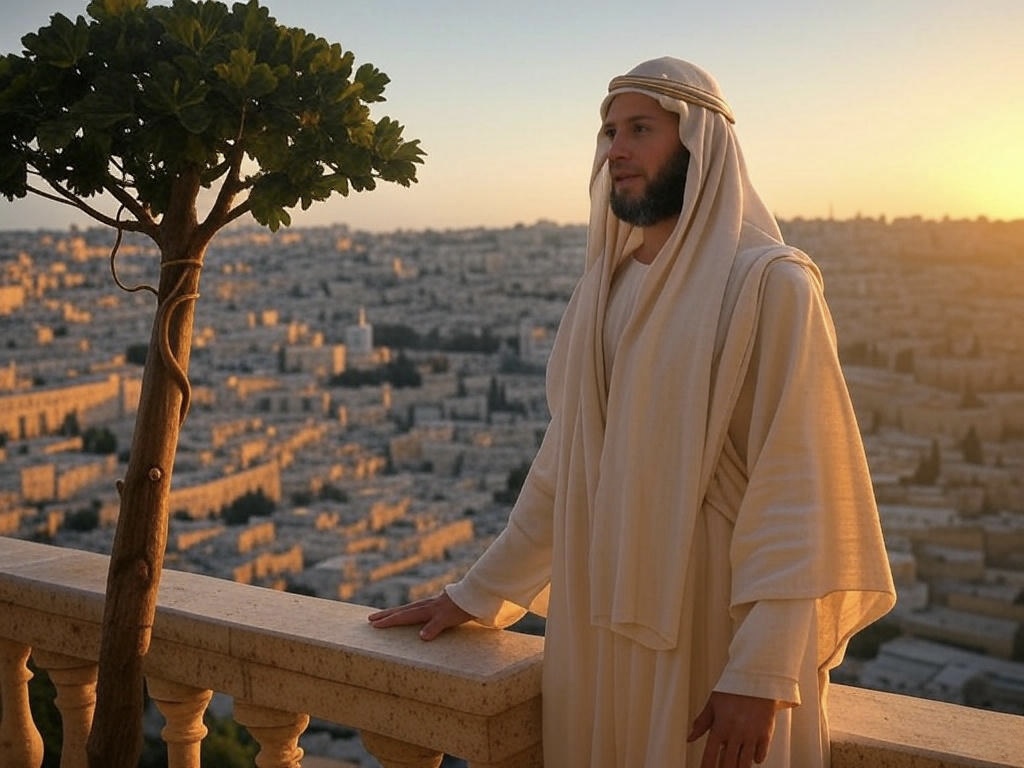
    1 Kings 4:25“And Judah and Israel lived in safety, from Dan even to Beersheba, every man under his vine and under his fig tree, all the days of Solomon.”

    In plain English it’s saying that during Solomon’s rule, the people of Judah and Israel lived securely and without fear. From the northernmost city (Dan) to the southernmost city (Beersheba), everyone had their own land, food, and stability. Each person could rest under their own vine and fig tree, a symbol of peace and prosperity. It paints a picture of a nation at rest—no war, no oppression, just a time of blessing and stability.

    Final Thought:

    That’s the kind of life I want to cultivate—not just for myself, but for those around me. A life rooted in wisdom, in peace, in trust that God gives what’s needed when I seek Him first.

    How About You?

    Where in your life are you craving the peace of that vine and fig tree?

    What’s one step you could take to seek God’s wisdom first?

  • The Rhythm of Wisdom: Proverbs 8

    We’ve been going through the book of Proverbs, exploring its principles for life. This week, my pastor pointed out how Proverbs 8 is all about the rhythm woven into creation—and that stuck with me.

    He said creation has a rhythm, an order—a way things work best. Wisdom is woven into that design. Ignoring wisdom leads to unnecessary struggle in life. That’s what Proverbs 8 is all about.

    Wisdom isn’t something we construct—it’s something we align with.

    I’ve been thinking about that. Many times in life, I have acted as if I had to figure everything out on my own, believing the right path was something to discover through trial and error. But Proverbs 8 describes wisdom as something that was already there, from the very beginning. It’s part of the current that carries life forward.

    That’s not always easy to accept. I wanted to believe I could make my own way. It seems natural to shape life to fit what makes sense to me. But wisdom’s already there, holding up the foundation of everything, waiting for me to notice. That made me wonder—what does wisdom actually look like in action? As I thought back on the sermon, these verses stood out to me.

    Proverbs 8:30-31Then I was beside him, like a master workman, and I was daily his delight, rejoicing before him always, rejoicing in his inhabited world and delighting in the children of man.

    That passage struck me. Wisdom wasn’t just present at creation—it was rejoicing in it. Delighting in the world. Delighting in us. That changes how I see things. If wisdom isn’t just about rules but about joy—about alignment with the way things are meant to be—then following wisdom isn’t just avoiding trouble. It’s stepping into something deeper, something better.

    Proverbs 8:35-36“For whoever finds me finds life and obtains favor from the Lord, but he who fails to find me injures himself; all who hate me love death.”

    That last part gets me. It doesn’t say, ‘Whoever ignores wisdom makes God angry,’ or ‘Whoever ignores wisdom will be punished.’ It says rejecting wisdom is self-destructive. It’s not about some arbitrary set of rules—it’s about reality. You can ignore gravity, but that won’t stop you from falling. You can ignore wisdom, but that won’t stop the consequences from coming.

    And yet, wisdom isn’t hiding. It’s calling out. Proverbs 8 begins with a vivid image: Wisdom stands at the crossroads. She is at the busiest places in life. She raises her voice and offers direction. The problem isn’t that wisdom is silent. The issue is that I get so caught up in my own plans, my own wants, and my own distractions that I tune it out.

    The question I’m left with is this: Am I listening? If wisdom is real—if it’s already there, waiting to be recognized—then the way ahead isn’t about being clever or figuring everything out on my own. It’s about being humble enough to listen and open enough to find the joy it’s been offering all along.

    Final Thought:

    Wisdom isn’t silent, and it isn’t hiding. It stands at the crossroads, calling out, offering direction. The problem isn’t that wisdom is hard to find. The problem is whether I’m willing to stop and listen.

    How About You?

    Where do you hear wisdom calling in your life right now?

    How does wisdom’s joy in creation shape how you see it?

    Has ignoring wisdom ever led to struggle for you?