As we begin to study the book of Psalms at church, we step into two truths that are not easily resolved:
life is hard,
AND
God is good.
Pastor John said we’ll hear that repeated so often in this Psalms study that we might get tired of hearing it. But, repeating it presses us to notice the tension, to stay with the reality rather than escape it. We’re not meant to resolve it. We’re meant to dwell there, in the tension—and, not “but.”
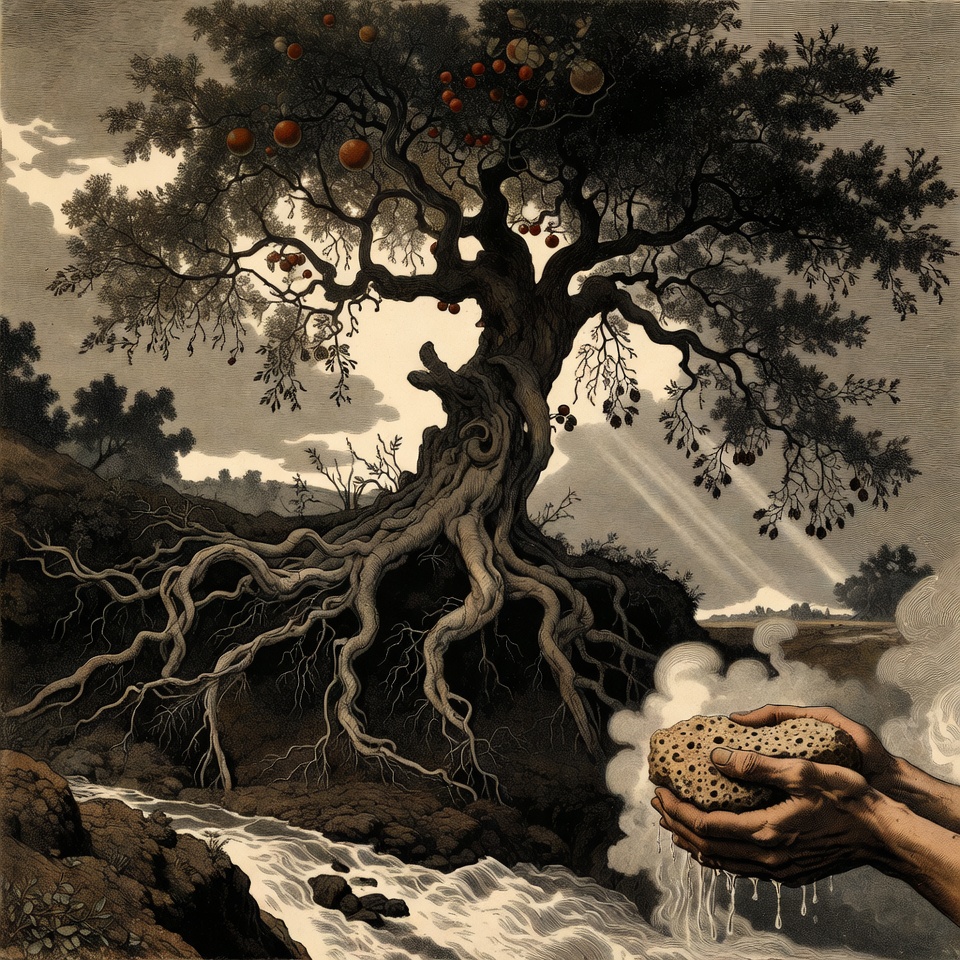
Life presses us like hands around a sponge. Pastor John brought up the metaphor, explaining that when life squeezes us, what comes out reflects what we’ve absorbed. Then he asked us: When we were squeezed this week, what came out?
If I’m being honest, when life squeezes me, when the weight of stress, fatigue, and the habits of a lifetime press in, some old patterns and residue from a life formed before Christ come out. Decades of living without Jesus soaked in quietly, shaping instincts and reactions I’m still unlearning.
When the pressure comes, whether in the form of a difficult conversation, a moment of anxiety, or an unexpected disappointment, what surfaces can surprise me. The escape into distraction. The quick irritation that rises before patience and grace can catch up. These are the things that come out when life squeezes, evidence of what I’ve absorbed over a lifetime and reminders that transformation takes time.
I am learning to unlearn old ways and let the love of Christ take root in my heart. This is what the gospel does for me, not just forgiveness for past sins, but transformation of present patterns. What Christ has done for me, He’s now doing in me.
Psalm 1:2—“But his delight is in the law of the Lord, and on his law he meditates day and night.”
Meditating on God’s Word, day and night, changes what flows when life presses. Life is hard, and God is good. Both truths exist together, and both matter.
As I meditate on his Word day and night, what comes out should be the attributes of God: patience, love, faithfulness, wisdom.
Pastor John explained the Psalms carry this tension without smoothing it, showing life’s weight alongside trust in God.
Psalm 1:3—“He is like a tree planted by streams of water, that yields its fruit in its season, and its leaf does not wither. In all that he does, he prospers.”
Life presses, yet rooted in God’s Word, what flows from us can bear steady fruit. The squeeze doesn’t change what’s inside; it simply makes it visible. This shows me how God uses time, pressure, and patience together.
Beginning here, with these ancient prayers and songs and Pastor John guiding us, I believe I will see that growth in real time. I’m being shaped into someone who, when squeezed, releases more of Christ and less of myself. The squeeze reveals what’s inside, and what I want revealed more and more is Christ.
It was Pentecost Sunday this past weekend and Brian Wagers was preaching. Somewhere near the end of his sermon, he said something that didn’t make sense to me at all, but somehow I knew it was important.
So I wrote it down.
“That which is assumed is healed, because that which is united to the Godhead is healed. So Christ’s full humanity means we receive the full deity of God in ourselves when the Holy Spirit rests upon us. So act like it.”
I didn’t know what it meant, but it sounded like seasoned Christian language, and something in me knew I needed to find out.
After I got home from church that day, I sat with it, looked up the theology behind it, and dug into what Brian was referencing.
Jesus didn’t just appear as a kind of human. He wasn’t God masquerading in flesh. He was fully human: body, mind, will, and emotions—and fully God.
Every part of humanity that He assumed is now joined to God. That’s what theologians mean when they say, “what is not assumed is not healed.”
The phrase comes from Gregory of Nazianzus, a fourth-century Church Father, writing against heresies that denied Jesus’ full humanity. His point was simple but profound:
“That which He has not assumed He has not healed; but that which is united to His Godhead is also saved.”— Gregory of Nazianzus Epistle 101, c. 382 AD
This became foundational in Christian theology, affirmed at the Council of Chalcedon (451 AD) and echoed across centuries: that Jesus took on the fullness of humanity to redeem the fullness of humanity. He had to take on the whole of humanity or none of it.
So now, when the Holy Spirit rests on us, we don’t just get guidance or peace.
We receive the fullness of God. Living in us. If that’s true, then God hasn’t just reached down.
He made His home in us.
And that’s where Brian’s last sentence landed like a stone:
“So act like it.”
That’s when I realized how much energy I still spend trying to manage how my faith looks to others.
I don’t lie about my faith. I don’t deny it. But I might be guilty of trying to soften the edges. I hesitate. I only share my experience with the gospel once it feels “safe.”
Especially around people I love: my parents, old friends, those from the Unitarian Universalist world I used to belong to. I know some of them already think I’ve lost it and have written me off. And I struggle to bring the good news to those closest to me.
But this struggle with boldness isn’t new for me.
Years ago, before I became a Christian, I went to a Sufi retreat with friends who had grown up going every year. And although I didn’t participate in the dancing in circles and the singing of chants late into the night, I was surprised when they started praising Jesus.
And for reasons I didn’t understand then, it offended me.
Looking back at my journal from that time, I found this telling entry:
I will praise the joy of Life. I will praise the Earth. I will praise the creations. But I won’t worship the Creator.
I had drawn a line in the proverbial sand back then. I didn’t want to go as far as worshipping my Creator.
And now, ironically, I find myself facing the same line—just in the opposite direction.
Back then, it was refusal to worship.
Now, it’s reluctance to witness.
Same fear. New disguise.
That’s why Brian’s sermon felt like a personal message to me.
“You should share the gospel more. Even though people will ridicule you… think you’re stupid for being religious… God is with you.”
He was reminding us what we carry. And how we ought to live in response to that.
Because I do know Jesus is real. I believe the gospel is true. And still, I catch myself holding back because I’m afraid of being dismissed before I even begin.
But then I read Acts 2 and the story of Pentecost.
Peter stands up in front of a crowd that’s already mocking him. “They are filled with new wine,” someone sneers. But Peter doesn’t explain himself. He doesn’t defend his tone. He doesn’t soften the message.
He just preaches.
That’s what struck me most this Pentecost, not the speaking in tongues, but the surrender. The apostles had been hiding weeks earlier. Now they’re proclaiming Jesus, fully exposed, defying safety.
They had the Spirit. And that was enough.
Final Thought:
If the Holy Spirit really rests in me, if the fullness of God dwells in this ordinary body, then why am I worried about looking foolish?
Why am I still trying to sound smart enough and nuanced?
I have the Spirit of the living God.
Why would I care what anyone else thinks?
God is with me. God is in me.
So I’m done trying to control the optics.
I don’t need everyone’s approval. I have His presence.
Acts 2:15–16—“These people are not drunk, as you suppose… but this is what was uttered through the prophet Joel.”
I recently got this Scripture Journal Bible — the kind with the text on one page and blank lines on the other for notes. It’s a hefty thing, about 28 pounds of Scripture, but I love how it invites me to wrestle with the words. I’m starting with Colossians, studying it in my own time. I am leaning on sermon videos my pastor preached three years ago when he first came to our church.
At the start of Colossians, Paul greets the believers of Colossae as saints and faithful in Christ—not because they’re perfect, but because the gospel has taken hold in their lives. Roots like that grow something. He reminds them that this same gospel is spreading all over the world, just as it has in Colossae. It’s a living thing, spreading and producing, and it’s doing the same in us.
Colossians 1:9-10 —”And so, from the day we heard, we have not ceased to pray for you, asking that you may be filled with the knowledge of his will in all spiritual wisdom and understanding, so as to walk in a manner worthy of the Lord, fully pleasing to him, bearing fruit in every good work and increasing in the knowledge of God.”
Paul prays they’d be filled with the knowledge of God’s will and live it out, bearing fruit in every good work and increasing in the knowledge of God.
The Cycle of Faith
It’s a cycle that keeps unfolding—learning who God is, stepping into what He calls us to, seeing fruit spring up, then digging deeper.
The cycle works like this: As we seek to live in a way that pleases God, He fills us with His wisdom and strength. This filling equips us to live out the gospel in our actions, which in turn bears fruit—visible evidence of a life rooted in Him. As we bear fruit, our understanding of God deepens, drawing us closer to Him. The more we know Him, the more we rely on Him, and the more He fills us again. This ongoing cycle of learning, living, bearing fruit, and growing in knowledge keeps our faith alive and active.
This cycle of learning, living, bearing fruit, and growing in knowledge isn’t just theoretical—it’s something I’ve seen in my own life.
For years, I struggled with my temper. My anger would go from zero to ten in an instant, and I often felt powerless to control it. But since I’ve been saved, it’s like a weight has lifted. I won’t say I never get irritated, but now, instead of rage, it’s more of an annoyance that passes. God is reshaping my reactions, teaching me patience, and helping me forgive—not just others but also myself. That’s fruit I could never have produced on my own.
Another change I never expected was in how I interact with people. In my 30’s, I became more withdrawn, socially awkward, and anxious in large groups. I mainly stayed at home. But as I’ve grown in faith and become part of a church, something shifted. I’m more open, more comfortable in crowds, and happy to engage with people. I see this as part of God’s work in me, drawing me out of myself to be part of something bigger.
And it hasn’t just been me. My wife has seen these changes too. They’ve strengthened her own belief that God is real and working in our lives.
Paul’s words to the Colossians hit home because, like them, I’ve wrestled with faith. I’ve let the world’s expectations shape me. But when I look at what God has done, I see that faith isn’t static. It moves. It grows. It bears fruit.
And this cycle isn’t new—Jesus points it out too:
John 15:5—“Whoever abides in me and I in him, he it is that bears much fruit.”
If I’m not abiding, nothing will grow. Am I truly abiding in Him? Abiding means staying rooted in Christ—trusting, obeying, and drawing life from Him. And that is only possible because of what He’s already done for us:
Colossians 1:13-14—“He has delivered us from the domain of darkness and transferred us to the kingdom of his beloved Son, in whom we have redemption, the forgiveness of sins.”
This sums up the core of the gospel, plain and simple—what God has done for us through Christ. We were trapped in sin, but God rescued us, gave us a new kingdom, and forgave us through Jesus. It’s the greatest good we’ve been given, a gift—not something we are owed. Before, I saw faith as something personal, maybe even individualistic. But seeing God as a loving Father who’s rescued us changes how I live it out—faith isn’t just mine; it’s meant for something bigger.
Faith That Moves
That’s why Paul’s words to the Colossians resonate—like them, I’ve wrestled with what faith really is and how easily extra things creep in.
The Colossians were tangled up in extra stuff—pagan ideas, Jewish legalism, and they blended them into their faith. I get it. It’s easy to let the world’s expectations creep into my thinking in my pursuit of approval or security. But Paul’s prayer cuts through: Faith that’s alive moves. James drives it home:
James 2:17—“Faith by itself, if it does not have works, is dead.”
It’s not about earning—it’s the natural overflow of a life deeply rooted in Christ. What is my faith producing?
The good news is, God doesn’t leave us empty-handed. He fills us with His strength, His knowledge, His patience. It’s not my effort holding this up—it’s Him.
Philippians 1:6 — “He who began a good work in you will bring it to completion.”
He’s the source; I’m just a branch, meant to live this gospel out and let the cycle keep going—learning, growing, bearing fruit.
Abiding in Christ means staying rooted in Him, even when it’s uncomfortable. I’m slowly letting go of the fear of my friends and family judging me for becoming a Christian and accepting Jesus as my Lord and Savior.
Just today, a friend confronted me with strong language, asking if it was true that I was “born again”. A year ago, that might have shaken me. But these last two years have been transformative for me and my family. As we grow in faith, we feel more whole, like we’re on the right path.
Things are falling into place—not because life is easier, but because God keeps reinforcing our faith and guiding our steps. And I know He’s not done. The work He started in me—He will see it through.
The cycle of learning and growth keeps going.
Final Thought:
My goal today is to lean into this—learning God’s will and living it for His glory. Colossians 1:10 ties it together: a life pleasing to Him bears fruit and deepens our knowing. Today, I can abide in Him by trusting His lead and letting that fruit show through how I live.
How About You?
What fruit is your faith producing?
Where have you seen spiritual growth that surprised you?
We’ve been going through the book of Proverbs, exploring its principles for life. This week, my pastor pointed out how Proverbs 8 is all about the rhythm woven into creation—and that stuck with me.
He said creation has a rhythm, an order—a way things work best. Wisdom is woven into that design. Ignoring wisdom leads to unnecessary struggle in life. That’s what Proverbs 8 is all about.
Wisdom isn’t something we construct—it’s something we align with.
I’ve been thinking about that. Many times in life, I have acted as if I had to figure everything out on my own, believing the right path was something to discover through trial and error. But Proverbs 8 describes wisdom as something that was already there, from the very beginning. It’s part of the current that carries life forward.
That’s not always easy to accept. I wanted to believe I could make my own way. It seems natural to shape life to fit what makes sense to me. But wisdom’s already there, holding up the foundation of everything, waiting for me to notice. That made me wonder—what does wisdom actually look like in action? As I thought back on the sermon, these verses stood out to me.
Proverbs 8:30-31 –Then I was beside him, like a master workman, and I was daily his delight, rejoicing before him always, rejoicing in his inhabited world and delighting in the children of man.
That passage struck me. Wisdom wasn’t just present at creation—it was rejoicing in it. Delighting in the world. Delighting in us. That changes how I see things. If wisdom isn’t just about rules but about joy—about alignment with the way things are meant to be—then following wisdom isn’t just avoiding trouble. It’s stepping into something deeper, something better.
Proverbs 8:35-36 –“For whoever finds me finds life and obtains favor from the Lord, but he who fails to find me injures himself; all who hate me love death.”
That last part gets me. It doesn’t say, ‘Whoever ignores wisdom makes God angry,’ or ‘Whoever ignores wisdom will be punished.’ It says rejecting wisdom is self-destructive. It’s not about some arbitrary set of rules—it’s about reality. You can ignore gravity, but that won’t stop you from falling. You can ignore wisdom, but that won’t stop the consequences from coming.
And yet, wisdom isn’t hiding. It’s calling out. Proverbs 8 begins with a vivid image: Wisdom stands at the crossroads. She is at the busiest places in life. She raises her voice and offers direction. The problem isn’t that wisdom is silent. The issue is that I get so caught up in my own plans, my own wants, and my own distractions that I tune it out.
The question I’m left with is this: Am I listening? If wisdom is real—if it’s already there, waiting to be recognized—then the way ahead isn’t about being clever or figuring everything out on my own. It’s about being humble enough to listen and open enough to find the joy it’s been offering all along.
Final Thought:
Wisdom isn’t silent, and it isn’t hiding. It stands at the crossroads, calling out, offering direction. The problem isn’t that wisdom is hard to find. The problem is whether I’m willing to stop and listen.
How About You?
Where do you hear wisdom calling in your life right now?
How does wisdom’s joy in creation shape how you see it?